SANDAG Closed Session Dec 5: Please Support Transit and Do Not Appeal RTP Ruling

Dear Elected Representatives of San Diego County:

Thank you for your service to our region. I know each of you came into your positions with different goals and visions for change you hoped to effect, and you all serve many members of your respective communities with integrity and valor. Politics can be an ugly business, and preservation of soul and best intentions can fall by the wayside at times.

It is especially difficult, I would imagine, when devoted and engaged citizens disagree with your actions as elected officials. The sentiment of many nonprofit and volunteer community members, many of whom work full time jobs and are raising families, is that their voices and the advocacy they pursue are dismissed when more powerful interests are at play.

As a San Diego County resident, I sometimes commute by bicycle, take the Coaster when possible, but mostly sit in freeway traffic on a regular basis. I would GREATLY prefer to take functional transit than suffer the same traffic congestion on a wider freeway in the years ahead.

I have attended a few SANDAG meetings over the years, and have been dismayed to hear my comments dismissed by some Board Members as “not representative of the community” and/or “infeasible.” That despite the fact that some of the same Board Members have vocally bemoaned the small number of members of the public who attend and participate in public workshops and SANDAG meetings.

The transit and bike advocacy public is showing up in greater numbers over the past months. Many are regular, busy people who deem this engagement with you worth their time.

However, we are still being dismissed, both in the public comments some of you have made and functionally in the Regional Transportation Plans you direct staff to prepare, then approve. Our preferences are too often dismissed in the funding allocations of budgets we provide, yet you control.

I love San Diego County. I went to college here. I am raising my children here. My daughters and I love playing at the beach and camping in the mountains. Now that they are teenagers, I wish they could safely and conveniently go to the beach, shopping, or the movies with friends via transit, avoiding the dangers presented by cars. It is with this love for our natural and built environments, my family, and my fellow citizens that I approach my advocacy, and it is personally upsetting when my science-, data-, and law-supported views are so readily dismissed.

I submit these comments in my personal capacity, but I also serve on the board of the Cleveland National Forest Foundation. While CNFF has engaged in many SANDAG planning processes over the years, including privately funding infill and transit studies with our modest budget and presenting these as options staff could build upon, our input is largely unwelcome. Efforts to engage meaningfully are treated disparagingly by some members of the staff and Board, as though our mission to increase quality of life in the region and protect environmental resources is somehow in conflict with SANDAG’s mission. Indeed, had our straightforward, pragmatic input over the years been met with an attitude of collaboration rather than hostility, Friday’s meeting would be about moving San Diego forward rather than the topic currently on agenda. Unfortunately, I have come to believe some at SANDAG think their role is to increase roads; not mobility.

I am writing to quite honestly share from my perspective, because I maintain hope that you as our regional leaders will recognize signs that the winds are changing, and you will likewise adjust your sails to facilitate moving the region in a new direction (pun intended). We are reaching a critical point of climate disruption, public awareness, a “peak road” condition with disappearing open space, and copious helpful data from other populous regions with successfully implemented transit and infill scenarios. Rather than waste more regional resources, including time and money, in litigation, I encourage you to be wise leaders in these changing times.

If you vote on Friday to further appeal the 2050 RTP ruling, I will be a voice of dissent. I will be critical of that choice, but I hope you know better now the “why” and “who” of yet another San Diegan who has a different vision for our shared future. Regardless of your vote, I maintain hope that you will be open to new information in the years to come, and be willing to adjust your policies accordingly.

The younger generation among our population is more interested in mobility and online connectivity than car ownership. I hope you will represent the future, rather than dig in on transportation planning principles of the past that have created many of the problems that impact all of us today. There are many of us who wish to be partners in that process, and the benefits outweigh the challenges.

Thank you for your consideration of my contributions to this regional conversation.

Posted in Uncategorized | 1 Comment

A heart for justice.

There’s a song that’s become popular in some churches over the last decade or so that includes a line… “Break my heart with what breaks yours…

I believe we are all made in God’s image. Being made in God’s image is a fundamental attribute of being human – not just for Christians, but for every person. And God loves each of us as if there were only one of us.

Most of my friends are justice-minded: opposed to oppression of any kind, though some issues resonate more than others based upon life experiences. This hatred of injustice and pursuit of justice is like God’s heart. In God’s image.

Discussions around the Hobby Lobby decision are, in my mind, two sides of the same slippery-slope coin. On one: people are genuinely afraid of being compelled to support something to which they are morally opposed. They take the argument to the extreme (beyond medical and legal realities), and sympathize with presumed pro-life employers who would be forced to fund employee abortions. Some of these are rolling their eyes at “liberals,” saying their arguments are invalidated by the “narrow” rulings. They’re celebrating what they see as a victory for religious freedom, which is a very American freedom. Some even think it’s appropriate for nonprofits to be treated like churches, some of which refuse to provide contraception of any kind for any employee.

On the other side: women’s privacy. Women’s employment options. Unintended pregnancies for those who can least afford them. My ability as a single parent to provide for my children without invasive conversations with employers. A whole new opening to awkward and unprofessional conversations between pretty young female employees and their male managers, who might not hold the same religious views as the company owners, and who might take advantage of conversations about presumed sexual activity. Erosion of doctor-patient confidentiality and access to medication deemed most appropriate (some people are allergic to many forms of birth control, for example, and some have to take it for reasons other than sexual activity – whether single or married).

The worst possible outcome for everyone: An increase in *actual* abortions because employers institute policies wherein they will not fund any form of contraception on religious grounds. (Monday’s ruling was clarified on Tuesday, indicating this is a very real possibility).

This is a travesty of justice. The implications double down on the notion that sex is for women to avoid. The government is endorsing employers’ moral control of straight female employees’ private lives, presumably enforcing standards of “chastity.” This is invasive, and assumes birth control is only for unmarried whores.

It may negatively impact any women applying for jobs, because most employers don’t list the full range and limitations of healthcare benefits prior to hiring. If a woman asks about contraception during an otherwise successful interview, assumptions will be made and she may be passed over. Or the hiring manager may be a male who is inordinately interested to learn the new young employee is presumably sexually active. There are so many unprofessional, awkward, innuendo-laden moments experienced as a woman that are not readily defined as sexual harassment in the workplace that will be exacerbated in this scenario.

One right within our country’s laws (freedom of religion) should not force those changeable standards on others. Christians cannot dictate chastity to the rest of the unmarried world, or even within the walls of a church containing humans with free will. There are so many layers of judgment, our rights as Americans, rights of others who do not subscribe to Christianity, and many discussions this week are triggering notions of authoritarian dominance that have nothing to do with God’s love and should have nothing to do with laws in America.

So, yes, my heart for justice is breaking, and I’m tired of *only* men establishing rules that only impact *only* women.

Posted in Uncategorized | 4 Comments

Welcome home, we wish you were dead.

Congratulations, those of you who think you know all the inner workings of our government and the hearts and minds of President Obama, Sgt. Bowe Bergdahl and his father. His welcome home party has been canceled.

All you lovers-of-American due process who have decided Bergdahl deserved to die as a tortured POW, who believe Obama probably set the whole thing up because he’s secretly a Taliban sympathizer, good job. This soldier’s hometown is afraid to openly welcome him home.

Your mind is made up. He shouldn’t have due process within the military’s protocol, because YOU’VE already decided he is unworthy of anything but a rotting, torturous death at the hands of the Taliban.

You can spend days obsessing over details and portions of “evidence” that “prove” the position of your already-made-up-mind that Obama was negligent to free him in exchange for Guantanamo prisoners (to date, President Obama has freed 88, compared to more than 500 released by President Bush).

You can ignore the parts of the story that don’t fit your narrative (leadership problems in his unit, for example, that his parents thought they were being ignored by Obama because they’re Republican Ron Paul supporters, that top GOP leaders were supportive of an exchange until it became a political hot potato, the intentions and heart of a father doing everything within his limited reach to keep his son alive and get him home).

You can ignore these or explain them away with a shallow, self-satisfied explanation if that helps justify your hatred and judgment of our country’s leadership – hatred you somehow find patriotic and comforting.

It’s unfortunate that this man, who has clearly suffered much, is doomed to a marked, dishonorable future, regardless of the facts (that none of us actually know at this time). If he commits suicide (as do so many of our soldiers) as a result of his past trauma and, more likely, losing in the Court of Public Opinion before he could even set foot on U.S soil, how much more of a waste will this exchange have been?

I can relate on one point: I am not thrilled that *every single one* of our presidents of the last 20 years or so have acted in flagrant violation of U.S. laws surrounding military action. However, even at my lowest point of disgust for President Bush’s wars, I assumed he was surrounded with intelligent advisers and was privy to information I was not.

As for me, I’m going to leave any further investigations and potential punishment up to the proper authorities who have access to privileged information, and who I’m sure will be speaking to the Sgt soon. I’m going to celebrate from the heart of a parent, finally able to gratefully wrap arms around a long-lost son. And I will not doom him for a list of presumed offenses and malintent ascribed to him based upon spotty information.

Rejoice with me, for I have found my sheep that was lost.’

Posted in Uncategorized | Tagged , | Leave a comment

He wants them to leave Barrio Logan.

Chris Wahl, spokesman for Shipyards industry executives, wants Barrio Logan residents to move away.

Play at sunset. Shipyards presence is ever-looming nearby.

Play at sunset. Shipyards presence is ever-looming nearby.

Under the new Barrio Logan Community Plan Update, the foreign-owned companies Wahl represents can expand up to 20% by right, then go through special permitting processes if they want to grow further.

Nobody is kicking them out, the zoning for the Shipyards remains untouched, and the Navy has unilaterally stated it will not leave San Diego because of the Barrio Logan Plan (if you heard that condos were being built at the Shipyards or that the Navy was leaving, it’s because Shipyards representatives like Wahl lied about it).

Pollution and picket fences.

Pollution and picket fences.

The facts of the Barrio Logan Plan – assurances that existing Shipyards businesses are protected – are not good enough for the wealthy executives, however. They would prefer the residents move away and quit impeding their unbridled profits. They think the people who live there should disappear, because they don’t want to be forced to be responsible neighbors by submitting to sensible restrictions on future growth.

Chris Wahl said recently on KPBS Midday Edition, “…you can put community housing in any city or any part of the city.”

He also told KPBS in September 2013: “Everybody wants to have a better separation of uses, we are all on the same page on that,” he said. “But it can’t be at the expense of the shipyards and their future.”

‘Separation of uses’ means “We’ll stay; you leave.”

To San Diego’s credit, there seems to be support and sympathy for the Barrio Logan residents in their battle for a healthier future versus the Shipyards – especially when contrasted with recent deep disappointment in vocal, anti-density members of the Clairemont community.

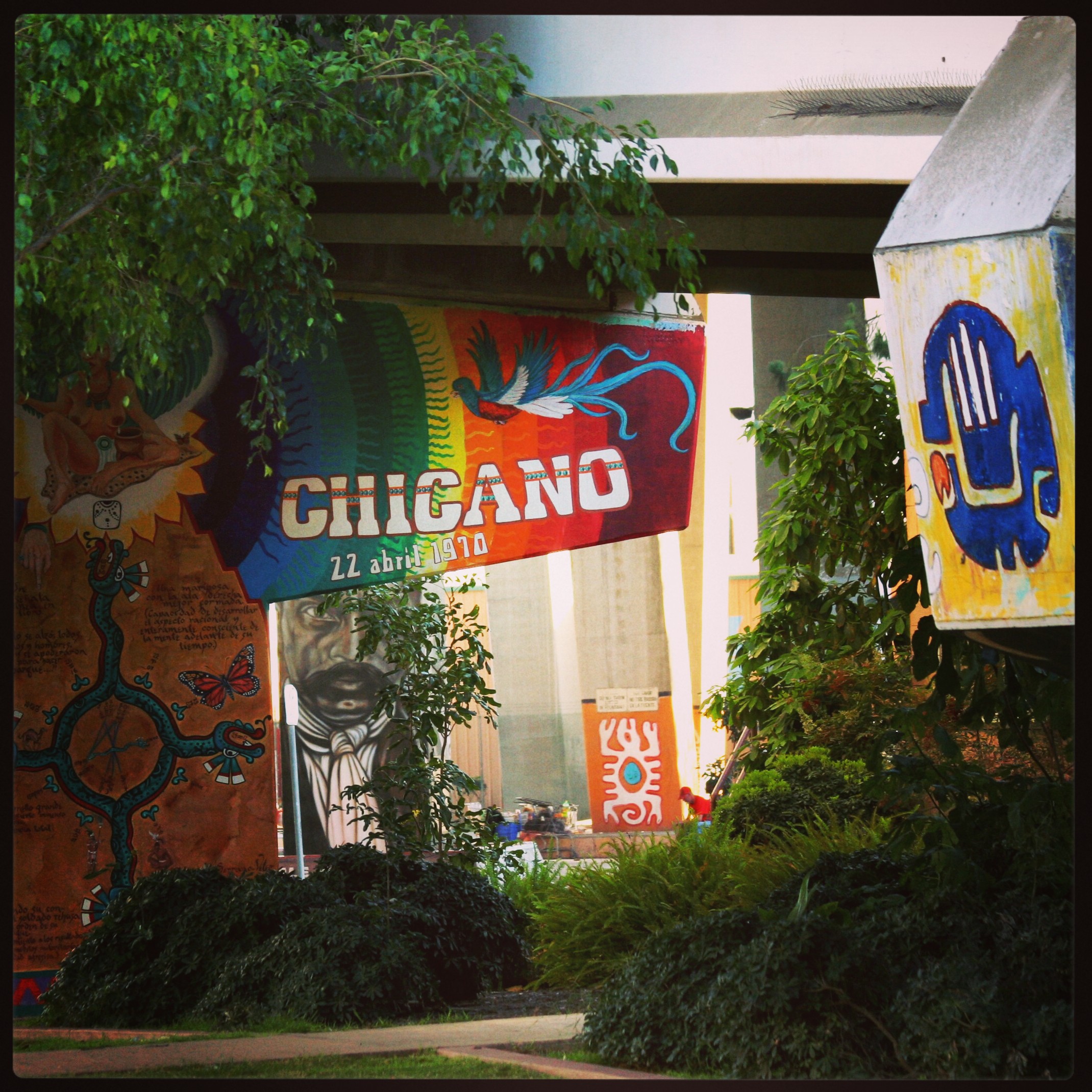
Chicano Park: Barrio Logan roots run deep.

Chicano Park: Barrio Logan roots run deep.

Will this respect and sympathy equate to YES votes on Propositions B and C on June 3?

Is Barrio Logan a legitimate community of San Diego residents? Do they have a right to live and thrive in the neighborhood they call “home?”

If the Shipyards executives had their way, the residents would leave. Where would they go? Another area of San Diego that is equally affordable because it has poor air quality? Should they leave San Diego, en masse, and go… where? El Cajon? La Mesa? El Centro? Arizona? Certainly somewhere out of sight.

These colors don't back down.

These colors don’t back down.

A “no” vote on these propositions is an intention to erase this community; to support the false notion that Barrio Logan residents are somehow less valid citizens of San Diego. To vote “no” is to endorse the sickness of their children. To vote “no” is to agree with Chris Wahl and the executives he represents that the residents should move somewhere else. A “no” vote endorses lying and bullying to get a public vote in an attempt to overturn Barrio Logan’s hard won plan.

I hope you’ll vote YES on June 3. If you live in San Diego, you have until May 19 to register to vote.

You can also financially support the Yes on B and C campaign, like them on Facebook, follow them on Twitter, and tell your friends that a simple YES vote on June 3 will help right some of the injustices suffered by this culturally rich, valuable community.

They are San Diego, their children are our children, and Barrio Logan voices will not be silenced.

Barrio Logan knows how to come together.

Barrio Logan knows how to come together.


Posted in Uncategorized | 1 Comment

Faux Transportation Planning in San Diego: Racism and Red Herrings

There has been fiery discussion in San Diego over the past two weeks regarding issues of increased transit and density to meet the needs of the growing urban community, and objections to density impacts by some members of the current population regarding potential changes to their neighborhoods.

Some of the discussion, including among my friends, has clearly indicated that many engaged citizens want to see improvements in density (urban housing), transit oriented development, and forward-looking planning, and many have criticized the vocal residents in opposition to potential height limit increases for being shortsighted NIMBYs.

While there are a number of areas within urban San Diego County that are already zoned for greater density – many in prime locations for redevelopment – there is a larger perspective that has been largely ignored in the recent conversation.

More of this, please.

More of this, please.

The San Diego Association of Governments (SANDAG) serves as the region’s transportation planning agency. SANDAG is responsible to provide regional mobility for residents and comply with various state and local laws in its planning process. The Board is comprised primarily of elected leaders from around the County, and they occasionally provide leadership direction to staff. However, they primarily vote up or down (sometimes with proposed changes) projects and proposals prepared by SANDAG staff.

The planning processes are lengthy and are, by design, data driven. Data like: who rides existing transit? Where do people live and commute? How will San Diego’s population grow in the upcoming years? What areas are primed for such alternatives as increased cycling infrastructure, and will people utilize the investments?

SANDAG enjoys an expansive budget, and awards funding for regional projects, such as those promoting active transportation. They do not technically enjoy land use authority to drive transit oriented development (TOD), but can award or withhold funding from cities within the region who show or lack smart growth leadership. In the SB 375 greenhouse gas reductions framework, it is SANDAG’s responsibility to show leadership in this regard.

SANDAG's attitude about input from citizens.

SANDAG’s attitude about input from citizens.

There is a great deal of discretion in the upper levels of staff leadership at SANDAG regarding allocations of staff resources. While there are multiple projects the massive agency promotes at a given time, some are quietly prioritized.

The I-5 corridor is one such SANDAG priority. SANDAG is currently pushing the region toward expansion of the I-5 freeway, pairing it with some supportable coastal walk and bike trail and lagoon health improvements (though some of these lagoon deficiencies were actually caused by inadequate environmental mitigation of previous I-5 projects).  Its partner in this effort is Caltrans, which has funded a Coastal Commission staff member for a little over five years.

Many SANDAG projects require a public input process by law. Projects mysteriously prioritized at the upper echelons of SANDAG staff enjoy the greatest dedication of resources in the outreach process.

Public outreach and education are done in the name of gathering feedback, but other than gathering the comments and formally replying to them, they do not substantively alter the predetermined goal: widen freeways.

Last April, I attended one of their large public meetings on the PWP/TREP (Public Works Plan/Transportation and Resource Enhancement Program). I was appalled at the public resources on display at this overblown dog and pony show – my tax dollars lavishly spent on a sham of a public process.

How much money has been spent to play up the most attractive portions of the North Coast Corridor plan and related elements – the most attractive portions, of course, representing the smallest SANDAG investment (widening the freeway costs the most)?

SANDAG’s desired I-5 widening and related good PR projects also require amendments to the Local Coastal Plans (LCPs) of all coastal cities impacted by the project. As such, SANDAG staff has been faithfully making regular presentations at the Planning Commissions and City Councils of these cities, updating the LCP decision makers on the progress and details of various elements, though rarely discussing the foregone conclusion of widening the freeway during these information dumps. Rather than each city carrying the responsibility to develop its own LCP amendment and risk rejection by the California Coastal Commission, SANDAG and Caltrans are developing one LCP amendment for the North Coast Corridor. Staff essentially pitched it to the coastal cities as their only option to save resources, though in so doing these cities abdicate local control over project impacts to their residents.

Coaster

If you build it, they will come. But only if you build it right.

The current version of the I-5 corridor plan and its elements commit the region to widening the freeway, but does not commit to a date-certain for double tracking the Coaster, let alone the modeling of a transit first alternative. Instead, the assumption is that based on their ridership data, only Low Income Minorities (LIMs) use alternative transportation. In a case of applied racism, LIMs’ lower-priority needs are assumed to be met by providing buses on the to-be-expanded freeway instead of efficiently expanded rail. Poor people aren’t entitled to go anywhere quickly, so efficient transit isn’t a SANDAG priority. Perhaps the Coaster will be double tracked sometime around 2035.

As in the case of the double tracking of the Coaster, SANDAG’s long range plans contain some extremely supportable transit network expansion components. However, their implementation strategy is to almost exclusively widen highways FIRST, and push implementation of the rail components to some unnamed, noncommittal point in the future. They claim paid HOV lanes will fund rail expansion, refusing to consider that a commitment to a first phase complete transit system with reliable service in our urban areas would offload our existing highways and also provide an ongoing revenue source. They consider unconstrained scenarios and deem transit-first approaches to be the most desirable, then deem them infeasible.

Someone at the upper levels of SANDAG is not only setting the staff allocation priorities, but project implementation priorities, and the lion’s share of resources are dedicated to widening highways. Highways are the goal, so fully integrated transit is “infeasible.”

Returning to the recent example of unhappy Clairemont residents, the controversy is a prime example of the problem with piecemeal, line-by-line trolley expansions absent a commitment to integrated regional transit. SANDAG throws just enough money at siloed projects to set them up for failure: a self-fulfilling prophecy to prove their claim that “San Diego isn’t ready for transit” and justify more sprawl.

The North County Sprinter is one such example. Despite the availability of other rail cars used in the United States, they implemented cars only used in Europe, on incompatible old freight tracks. Then, they outsourced maintenance to slash costs. In retrospect, it was built to fail.

I generally advocate for light rail expansion over freeways-dependant bus rapid transit (BRT) for a number of reasons. The trolley and Coaster are more pleasant to ride and are vastly more efficient than the bus, and would, if fully operational, attract more ridership. Buses are slower and are subject to the same stops and starts as traffic, which can frankly be nauseating and lend itself to scheduling abnormalities. They are generally more expensive to maintain over time than rail (the buses themselves and wear and tear on roads), and perpetuate fuel-based transportation and greenhouse gases.

SANDAG promotes BRT over rail almost as a rule (remember the LIMs, referenced above?). However, SANDAG can’t even do BRT properly in San Diego.

SANDAG treats "LIMs" - Low Income Minorities - like garbage.

SANDAG treats “LIMs” – Low Income Minorities – like garbage.

The current battle over height limits and the trolley expansion into UTC is another project SANDAG seems to be dooming to failure. Building a new line parallel to an existing line (coastal rail) that has not yet been built out is a wasted and obviously controversial investment. Instead, SANDAG should connect the Coast and Amtrak rail service via a tunnel from Sorrento Valley and Rose Canyon with a two-track single-platform station underneath University Town Center to serve commuters from the north (there are more of these) as well as the south. It would shorten the line, eliminate much of the grade for all trains (including freights), and would be more efficient, which would save operations costs in the future.

Given its clear commitment to highways expansion prioritization, it seems SANDAG *wants* transit to fail in San Diego. More taxpayer-funded roads is the equivalent of sprawl development profits on the taxpayers’ dime. Road widening does not meaningfully reduce traffic congestion, and only temporarily benefits drivers. Following years of congestion-exacerbating construction, the traffic returns to its prior frustrating overcrowding within two to three years. Cue the renewed efforts of SANDAG to widen them yet again.

While I support higher density and smart planning and realize that the interim stages can be frustrating and inconvenient,  the case of the project proposal that so recently upset Clairemont and some UTC residents is a red herring. We need our leaders to lead intelligently, stop inhibiting urban progress (true smart growth), and stop wasting money on this faux approach to transportation planning.

Considering the vast public relations and staff resources committed in recent years to widening the I-5, I wonder: What would a similar outreach program look like if the top-down decisionmaking was pro-transit (not a little line here and there, but a complete regional solution)?  Who decides where and how those staff resources are allocated? There are certainly a growing number of engaged, bright citizens advocating for a dedication of our funds, managed by SANDAG, to be dedicated to rail and other transportation choices over highways expansion.

I dream of a regional transportation agency that engages with the community planning groups, educates them to regional possibilities of comprehensive, functional transit to connect neighborhoods and city centers, takes back feedback for ideal routes and maximized opportunities for increased density, and brings the collaborative solution to fruition. That’s the opposite of what happens now, and it’s a travesty of taxpayer waste, backwards planning, increased pollution, decreased quality of life, and impoverished democracy.

More light rail = preservation of San Diego's beauty, and more of us out of our cars to enjoy it.

More light rail = preservation of San Diego’s beauty, and more of us out of our cars to enjoy it.

Posted in Uncategorized | 2 Comments

Central High, Tuscaloosa

The year-long ProPublica study of resegrigation is powerful, and I’ve been thinking a lot about it over the past week, as well as some of the related Race Card Project follow-up stories I heard on the radio.

There are black kids in America who have never had a single classmate outside their race, and the data indicates their opportunities are, in fact, far below those of children who attend racially diverse or primarily white schools. It’s jarring.

cannot relate from a race perspective, but I can relate to growing up with limited educational opportunities in an economically depressed part of the country. We made the most of it, but it did not, for many of us, provide the ability to achieve our full potential.

I took most of the advanced classes in my northern Maine high school offered at the time, though I only took the minimum two years of French (the only language available with live instruction). I took Physics and Algebra 3 and Chemistry. We didn’t have AP classes. I loved drama club and music, but there was not public school music program that taught me to read music for singing. I managed to get the highest SAT score of my class, or so I was told at the time. I gave the message at Baccalaureate.

The Anatomy teacher told me once when I had a cold that my raspy voice sounded sexy, which made his class awkward thereafter. I respected the Chemistry teacher’s ability and her teaching approach was good, but she was a neighbor and at one time my Airedale Terrier beat up her Schnauzer and we had to get rid of my dog, so I held a grudge. She also was not a fan of my Christianity, and objected to me starting an after-school Bible study on campus, so that was a bit of a chilling effect on our teacher-student relationship. It’s not like I had the option to switch to a class with a different teacher.

The high school guidance counselor said: “Well, Sara, you seem really bright and you have your head on your shoulders. I’m sure you’ll do great.” Thanks for the pep talk, but I actually could have used some skilled guidance. I decided to only apply to Point Loma Nazarene with my healthy dose of academic over-confidence (I knew my education was lacking, but figured I was still competitive) and keep my pre-med options open (wanted to potentially be a missionary doctor), but eventually focused on Psychology. I still thought I’d eventually pursue my master’s and maybe even doctorate, but ended up with another hapless academic advisor who answered my questions with: “That sounds good.”

After three years of college, marriage, becoming a mother at 21, working part time a couple years, then becoming a single mama of two without her degree in my early 20’s, I felt extremely fortunate to land a decent-paying job as the receptionist for a San Diego tech firm. I had no doubt in my mind after a week of Welfare to Work that I only landed the job because I had some college education, showed aptitude and confidence, and (probably primarily) am white. I have no idea how a couple of the single mothers I met fared, especially one Latina with two young sons and no diploma, nor how they could manage working and caring for kids in this expensive city.

Even at around $15/hour, sharing a moldy two bedroom apartment with my Mom, receiving WIC and food stamps during the times I qualified, and receiving a partial childcare subsidy when my daughters were in preschool, I was frugally living paycheck to paycheck. That was with the privilege of being white, sharing living costs, and having some higher education (which should have been far more robust had opportunity been available).

I think of other kids who are growing up now doing the best they can in under-resourced schools, many with fine teachers who are also doing the best they can for their students. I think of those who also face added race stigma and extremely limited family resources, but who are certainly every bit as capable as me and more, I think our country is doing far too many people a disservice. The American Dream is a farce if it’s not available to those raised here with aptitude and willingness to work for it. AP students at Central High, featured in the ProPublica coverage, have apparent aptitude and willingness to work, but only two of the students attained the AP credit last year.

I’d love to put my smart kids in private school – they would thrive in the right environment, perhaps with less homework and a great deal more learning – but they’re doing pretty well. My eldest, especially, is interested in astrophysics and should probably be in a strong STEM program. They have a diverse group of friends, they take private music lessons, and I feed them giant breakfasts. They’re too often weary and frustrated with wasted class time and redundant homework, but they have far more opportunity than was available to me.

They enjoy far, far greater opportunity than the kids at Central High. We are doing America’s children a disservice. If only a small percentage of our brightest students are given the opportunity to achieve their full potential, how can America’s future be bright?

From ProPublica's The Race Card Project: Share your Six Words on Race and Education http://www.propublica.org/article/six-words-on-race-and-education-in-america

From ProPublica’s The Race Card Project: Share your Six Words on Race and Education
http://www.propublica.org/article/six-words-on-race-and-education-in-america


Posted in Uncategorized | Leave a comment

David Alvarez speaks peace.

At the second reading of the Barrio Logan Community Plan Update last October, David Alvarez wowed me.

Shipyards executives had just spoken in opposition and were threatening a costly referendum, and one spiteful community member opposing the Shipyards had personally disparaged Alvarez because she didn’t get everything she wanted in the compromise, either.

David’s response? We need a framework – the Community Plan – but there is room to modify some elements related to the the Plan to give people more peace following the approval. He made it clear that his door would remain open to even the most insulting naysayers.

When treated poorly, he responded with strength and kindness.

The Community Plan was barely approved by the San Diego City Council, an unfortunate byproduct of politicization of what should have been a wholly endorsed long-term collaborative effort. The Shipyards didn’t want any changes to their polluting businesses, Republicans wanted Shipyards campaign donations and didn’t want a political win for Alvarez. I recently wrote more extensively about this.

Councilmember Alvarez pressed through the opposition and led the compromise (Kevin Faulconer said he was “90% in agreement”) with the support of the Environmental Health Coalition, many involved Barrio Logan Residents, Council President and Interim Mayor Todd Gloria, and their colleagues on the Council.

Alvarez’s comments begin at 2:17:20, and the “peace” comments I just mentioned begin at 2:21:15 http://granicus.sandiego.gov/MediaPlayer.php?view_id=3&clip_id=5928

(Oh and if you want to see the amazing Livia Borak in action, her presentation immediately precedes Councilmember Alvarez’s comments at 2:16:25). They’re both worth watching!

Posted in Uncategorized | 1 Comment

Not mincing words.

I haven’t always had a deep-seated disrespect for Republican platforms or political strategies. I first registered as a Republican in college, because many in my family are conservative Christians. In my naivete I distrusted Democrats. I now know there are bad actors in both major parties and power can corrupt, but my faith is much more in line with the left than with what the right has become.

I fundamentally believe that people – made in the image of God – are good and helpful, regardless of political leanings or professed faith. Some politically active conservatives and progressives are the most loving, generous people I know. I carry an assumption that many from whom I deeply diverge in political opinion are doing a great deal for their local and global communities.

Although I strive to give individuals the benefit of the doubt regarding possible motivation and logic behind opinions with which I disagree, recent issues in San Diego have arisen that have diminished my willingness to assume nobility of the other side. Some recent and continuing actions are pure, unadulterated evil, and are indicative of an utter lack of integrity beyond positions on the issues themselves.

Morning in Barrio Logan, with Shipyards in the distance.

Morning in Barrio Logan. Shipyards in the distance.

First and foremost, the Barrio Logan Community Plan Update (BLCPU), approved by the City Council in September 2013, is near and dear to my heart.

San Diego’s Planning Division web profile on Barrio Logan opens with:

“Barrio Logan is one of the oldest and most culturally-rich urban neighborhoods in San Diego. From historic beginnings in the latter part of the 19th century to the vibrant mix of uses and people who reside and work in Barrio Logan, the neighborhood has played a vital role in the City’s development.”

Unfortunately, this “vibrant mix of uses” has toxic unintended consequences. In thirty years without a community plan update, Barrio Logan has become a neighborhood with many homes and industrial businesses side-by-side, poverty, and three times the asthma hospitalization rate as the rest of San Diego. Its air quality is among the 5% worst in California.

City staff, Barrio Logan residents, and area businesses worked for more than five years to develop a new plan and gradually move toxic industries away from homes, daycares, and healthcare facilities. The plan they developed was unanimously supported by the San Diego Planning Commission and recommended for approval by city staff who knew the plan intimately.

The City Council approval was led by Councilmember David Alvarez, who helped negotiate the final compromise plan by agreeing to a key term of Shipyards executives: that no new housing would be allowed in the buffer zone. Shipyards lobbyist Chris Wahl told the Planning Commission they could agree to the Plan with this condition at a hearing last summer.

Neither residents nor Shipyards executives got everything they preferred, but the end product is a compromise plan which will allow industry to continue to grow while improving the health of residents over time, with no changes to existing homes nor businesses. It includes flexibility to work with existing businesses and help them thrive. Minor changes can be made over time without scrapping the years-long effort, if needed. The Plan itself projects an increase in jobs from about 10,000 to nearly 15,000.

However, a victory for the Barrio Logan community and David Alvarez is seen as an affront to the power of the local Republican party.

High profile San Diego Republicans have picked up the “we didn’t get everything we wanted” ’cause’ of the Shipyards executives, who continue to wring their hands and claim that any impediment to their future growth will destroy their industry and force the Navy to leave San Diego, though these claims are speculative at best and contradict the Secretary of the Navy’s own reassuring statements that they will stay.

The messaging and actions in opposition to the BLCPU are the definition of depraved deceit. They are laced with misinformation designed to turn the rest of San Diego against the largely non-Caucasian San Diego neighborhood and those residents’ hard-fought preference for the future of their community. It seeks to doom them instead to a future of sickness from unrestricted growth into their residential neighborhoods of one of the most polluting industries in the city, and is intended to turn public opinion against mayoral candidate David Alvarez.

Council Member Kevin Faulconer, who is running against David Alvarez, voted against the Plan but said he was 90% in agreement with it. That’s better than the approval rating of most politicians.

KF Barrio LoganFaulconer then held a press conference repeating false claims about lost jobs to promote his campaign (his spokesperson later said those numbers were “not accurate”).

During NBC 7’s special election debate last week, Kevin Faulconer said David Alvarez exhibited a “failure of leadership” on Barrio Logan.

A failure because Faulconer and his Shipyards executives friends, significant campaign contributors, were only ninety percent in agreement with the Plan?

More like: a failure because Alvarez stood strong and did not capitulate to the ever-moving target of their demands, which essentially boil down to zero change to the way they do business. They want to maintain the status quo, continuing to make people sick, with zero accountability for the environmental and human health impacts they cause.

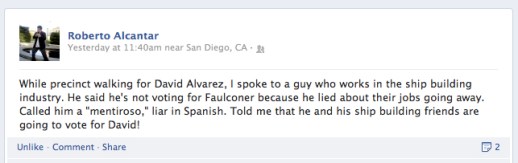
During that same NBC debate last week, Faulconer also said Shipyards workers feared for their jobs, supposedly as additional ‘proof’ of Alvarez’s ‘failure.’ Apparently he missed the news in December when those same workers said they felt betrayed by Shipyards executives and came out full-force in support of the Barrio Logan Community Plan.

Kevin Faulconer either is ignorant of this position taken by the same workers he claims to know and protect, ignored it because it doesn’t fit his narrative, or he’s lying to malign David Alvarez and bolster himself. I assume the second and third points are true.

Faulconer pays lip service to “working families” and their “middle class jobs,” but those families were betrayed by Shipyards executives, who lied to them to fabricate fear for their jobs. Now that they know the truth and publicly support the Barrio Logan Community Plan, they’re angry that they were used.

Faulconer keeps unrelentingly using them every time the issue is raised.
Roberto A

Roberto Alcantar’s January 25, 2014 Facebook status.

Shipyards workers don’t need Faulconer as their champion. The Barrio Logan Community Plan Update already protects their jobs, and the workers know it. Faulconer is proudly anti-union, so as soon as the fabricated story that these workers are in jeopardy no longer suits his political goals, he’ll either forget them or say they’re the enemy of industry for demanding middle class wages and benefits.

So: Shipyards executives negotiated in bad faith and/or lied to the City regarding terms that were agreeable and that they would not oppose in the Barrio Logan Community Plan.

They lied in their fear mongering about lost jobs and speculation about the Navy leaving San Diego, ignoring Navy statements indicating concern over human health and the Navy representatives’ unassailable comments that they will not be leaving San Diego. Nevertheless, Faulconer has decided taxpayers should spend up to $1 million to have this on the ballot.

Shipyards executives and their Republican allies’ deception on the Barrio Logan Plan is even more far-reaching and pervasive, however.

They obtained the legally required number of signatures to place a repeal of the plan on the ballot by paying signature gatherers, many of them brought from outside San Diego, and instructing them to spread coordinated lies about the Plan to the public. In the absence of truth telling, who wouldn’t sign a petition that claimed to protect jobs?

The Environmental Health Coalition (EHC), a Diego environmental justice organization, has focused efforts on improving the health of Barrio Logan residents through improved environmental conditions for many years. When it became clear that signature gatherers were lying to obtain signatures, EHC was left with no option but to either give up on Barrio Logan or file a lawsuit to challenge the validity of those signatures. I work for EHC’s attorneys at Coast Law Group, so have not only been involved as a passionate activist, but have read how extensively laws were broken in the course of the Referendum effort.

One of the documents related to the litigation explains:

“When the City did not accede to the Association’s demands and approved the Plan, the Association launched a well-financed and extensive campaign to overturn the approval by using its vast financial resources to buy what it could not obtain though the democratic process. The Association circulated a referendum to the Plan and opened its war chest to pay 50 signature gatherers to spread throughout the City for days straight. Using scare tactics to obtain signatures, these circulators uniformly told voters the Plan would shut down the shipyards and put condominiums or low income housing in their place. They stated the Navy was leaving San Diego and 46,000 jobs would be lost as a direct result of the Plan. They lied to the voters en masse as the Association paid them by the signature.”

When Shipyards representatives were confronted with these lies, their responses were varied. They suggested volunteers supportive of the Plan position themselves next to each of the 50 locations around the City where signature gatherers were posted in front of shopping centers, at farmers markets, and the like, and tell their own ‘side of the issue’ to potential signatories. They suggested the lies were limited to a few individuals, and that the public could bring misdemeanor charges against those contract employees to gather signatures for violating state law and city code. They denied any responsibility for the baseless claims their hired signature gatherers were making.

Shortly before the signature gathering process was complete, however, they issued corrected talking points to their signature gatherers. They tried to hide this document, because the fact that they circulated it means false statements prior to that were pervasive, and the signatures could be invalidated.

Republican City Attorney Jan Goldsmith has repeatedly said the problems with dishonest signature gatherers should have been reported to him (they were, immediately, by community members and public interest attorneys). Shortly after that time, however, Shipyards representatives met privately with him. He later refused to defend the City Council’s approval of the Barrio Logan Community Plan Update in the EHC litigation.

Not only have the Shipyards executives abused the referendary process, pulling political strings along the way, but they’re currently trying to subvert justice in the courts.

After Republicans on City Council and Shipyards executives tried to bully the Council to repeal the Barrio Logan Plan and failed, attorneys for the Shipyards executives filed an anti-SLAPP (Strategic Lawsuit Against Public Participation) motion in EHC’s lawsuit. They claim the lawsuit was only filed to stifle their political speech – aka their right to lie to the public.

The anti-SLAPP motion purposefully halted the litigation. It blocks EHC from rightfully obtaining documents and testimony proving the pervasiveness of the mistruths told to San Diego voters to obtain signatures for the Referendum. Their attorney strategically picked a hearing date eleven days prior to the June election.

EHC’s and Coast Law Group’s only recourse was to get an earlier hearing date in order to ask the Judge to allow the discovery phase of the lawsuit to proceed. The motion itself outlines an excellent recent history, and the follow-up reply further illustrates how outlandish the Shipyards executives’ claims have become in delaying the public interest and obfuscating the truth. I highly recommend reading both documents.

Separate from the legal process, many have weighed in on the maneuvering of the Shipyards executives, impacts to the mayoral election, and the future of how democracy will be done in San Diego.

I have no doubt some of the Shipyards executives involved are genuinely concerned about their ability to grow greater annual profits indefinitely. The facts as presented in the Community Plan and Navy commitments indicate they will be able to maintain and responsibly grow their profitability. But unbridled capitalism is overriding basic ethics. They’re willing to sacrifice human health on the altar of unencumbered corporate profit, and they’re willing to lie to do it.

They’re willing to waste up to $1 million in taxpayer money in order to do it.

They’re willing to steamroll local communities in order to do it.

If they can buy and lie their way into vetoing the fundamental wishes and basic health of the Barrio Logan community, there’s no reason they won’t do the same in other San Diego communities. This echoes Interim Mayor Todd Gloria’s strongly-worded statements on the matter: we must ensure democracy is not for sale.

I never previously had much strong feeling about Councilmember Faulconer one way or the other. I have been opposed to some of his anti-environment and anti-union votes over the years, but I never felt his personal statements were especially acerbic.

I now see Kevin Faulconer in an entirely different light, as well as those who stand up for the lies he perpetuates regarding Barrio Logan and the Shipyards.

By the time the web of lies is unwoven in litigation, the February special election will be over, and either David Alvarez or Kevin Faulconer will be mayor. It’s possible that the June election will have already determined the fate of Barrio Logan residents.

Faulconer is pursuing a path to mayoral victory on the backs of mostly Latino residents, and he lies about the community plan they fought hard to achieve. They already gave up much of their ideal vision to accommodate Kevin’s industry friends, but those Shipyards executives and local Republican operatives will not be appeased until they have broken democracy.

And yes, I am angry about it.

You should be, too.

Posted in Uncategorized | 5 Comments

Race and Listening.

Listen.

I don’t expect this to be profound, or very interesting, or much use for anyone except, hopefully, me, as it’s my personal narrative.

It is, perhaps, an exercise in vanity, but I don’t know how else to verbalize, move on and grow than by simply… verbalizing, moving on, and growing.

And there are many others who are vaguely but undeniably uncomfortable with the topic, but don’t want to venture to voice their thoughts because so much about it it is inherently personal yet taboo. I think choosing silence does society and progress a disservice.

Such silence is currently holding back conversation and collective self-examination in San Diego where only a few who write and talk about current affairs are willing to discuss race implications of the special mayoral election.

So here goes.

I’m a white girl from Northern Maine. I take that as a good thing, partly because I loved growing up in the trees, partly because (of course) I love my family, but also because not being white would have posed additional childhood challenges. I recognize there are many privileges of my childhood, including this.

Although I was teased a fair amount, I was never exposed to hateful racial slurs. I did hear ignorant boys use these slurs against a couple friends over the years, which baffled and angered me. There were only four black people I knew in my town: two friends who had been adopted by one of my favorite families, and one schoolmate and his Mom who had left war-torn Liberia. He had brothers, too, but they were older and didn’t know them. Other than these, the extent of my awareness of diversity included a Portuguese grandmother, mother, and her two kids who were just a little older than me. The Liberian mom and Portuguese grandmother attended my church and I spent time outside church with them sometimes. In my circles, that was it. It was woefully inadequate, but typical of rural Maine at the time.

As an avid reader and through school, I remember learning about World War II and Hitler’s atrocities. It made me worried and ashamed about being half German. My German ancestors had fled Germany in the 1800’s to Russia due to religious persecution, then Russia to the United States for the same reason. They mostly settled in South Dakota and farmed.

Although I knew my direct lineage had nothing to do with historically recent genocide, I began to think that portion of my whiteness was a problem. I tried to more closely identify with my much smaller percentage of Penobscot Native American, read books about moving quietly through the woods and living harmoniously with nature, and daydreamed about what it would have been like to live 200 years earlier in an actual tribe. It seemed much nobler an existence. I began to think of those with more darkly pigmented skin as inherently better than myself: more interesting, richer in heritage, living lives of greater depth and meaning.

I never spoke these things aloud. Why would I unintentionally insult my family and white friends? And what good would it do? I wouldn’t choose a different family for myself even if I could.

In fifth grade, my best friend, older cousin and I went with my Mom and Aunt to visit my grandfather, where he was living, teaching and gardening at a Baptist school for hearing impaired children in Baja California, Mexico. The students live at the school during the school year, and have strict schedules. We sat in on classes, quickly learned some conversational sign language, ate most of our meals with our new friends, played basketball and ran around during the recreation time, helped with Saturday morning chores, and attended church with them.

It was vacation for us, though, so we also got to leave with my Mom and Aunt to go to the beach, have a few meals in Ensenada, and shop. It was embarrassing to be reminded that our lives were dramatically different from those of the kids at the school when we got to do those things.

Over the days, we each developed a crush on boys there. At that age it meant catching an eye and blushing, playing chase on the playground, or trying to maneuver to sit near them during movie night. One star-filled evening before the boys were called to their dorm by the flashing lights, we girls and our three favorite boys found ourselves outside together. We shared a few prized moments of shy interactions: dreamy and magical and full of perfect pre-teen bittersweetness. We knew we would leave Mexico for the snowbanks of Maine soon. We would leave, and they would stay.

In the years that followed, I went back to Mexico a couple more times with Mom. My friends there teased that I had grown so much taller because in America, I got to drink real milk instead of the powdered stuff they had. I learned the sign for ‘giraffe’ as they good-naturedly teased me. It was my first real, in-my-face exposure to privilege. I rounded my shoulders forward a little to try to be less tall as my face burned hotly. They were so matter-of-fact about it, harboring no ill will, but I didn’t want there to be such stark differences between us.

Much later as a young college student, I met and grew to love a Hawaiian classmate. Through him, I learned of the oppression and takeover of those islands, and he shared story after story of everyday racism he encountered in school. He told me at the time he’d rather be speaking English than Japanese (as they would likely have conquered Hawaii if Europeans had not), but the history in his grandparents’ memories of making Hawaiian illegal to speak and modern barriers to land ownership, mockery of pidgin, and ongoing income inequality were very much in his awareness and identity.

When my part-Hawaiian daughters were small, I was worried that I didn’t have a kaleidoscope of friends. For some time I considered taking them and integrating into a predominantly black church, hoping that shared Christian faith and exposure to worship in other than a maddeningly, predominantly white congregation would be better for all of us. I grew tired of Southern California churches filled with mostly white, wide-eyed, enthusiastic 20-something couples, or mostly greying, white folks, where I didn’t quite fit in as a single parent. I dreamt of worship with families and individuals of all ages and colors. Homogeny seemed an indicator of a Christianity where something significant is missing, but seeking out a new church solely on grounds of race seemed disingenuous, too, so I never did it.

In my twenties I dated a wonderful and talented English man of Jamaican heritage for a couple years. At the time I imagined a future with him, perhaps even with another child or two. When I visited England on a business trip, I stayed the weekend in a hotel near his childhood home. I spent a small amount of time with some of his family, but while they were gracious and fun, I generally came away with the feeling that a white American divorcee with two kids was less-than their ideal partner for him. I didn’t know how to internalize that realization, and felt angry and sad and hopeless. But to respect and love him meant extending the same to his family. While it was never fully articulated at the time, recognition of the inherent challenges of that match contained wisdom.

The years have softened my experiences of odd and uncomfortable generalized guilt, but issues of race, privilege, and inequity swirl around us. We are by no means a post-racial society, though we must hold dearly to our family stories, traditions, and history rather than dilute the beauty of our diversity. There is much to work to be done to dismantle quietly persistent prejudices, income and opportunity inequality, poorly integrated entertainment, environmental injustice, and racially unequal law enforcement. We have a lot of ground to cover in the world of thoughts and policy, and avoiding the topic isn’t helping us progress.

In most of our cities and towns, in order to meet new people of any color we have to proactively seek them out. People are too busy, too shy, too stuck in routine to pursue new interests and meet new friends. The best some can muster is attending a celebratory international festival, but those are about going to taste and see, not engage. Cultural foods offer the lowest barriers and least commitment, and offer a culinary substitute for self-examination and the actions it demands.

Much has been recently written about celebrating others’ cultural cuisines – how it’s diluting those cultures when the cuisine takes off as a wildfire (mostly middle-to-upper class white people) foodie craze. While that’s true and caution is required, it also can be an on-ramp to awareness. Can be. I think sometimes we substitute impersonal food adventures for new interactions because it’s simply easier, but commodification can have a number of unintended consequences.

I don’t have any perfect solutions. As an adult, my social and environmental activism, engagement with current events and the world around me has led to an ever-increasing circle of contacts. As such, friendships gravitate around shared passions and interests. Social media in its ideal form helps bring people together. Life finally feels a little more like what “normal” should be.

I am pleased to see my daughters’ circles include friends from many different backgrounds. Many signs point to vast improvement with their generation, but there is still great disparity in school budgets – especially for families of color in poverty areas – which will reduce mobility and economic stability for those children as adults and perpetuate inequality.

I don’t think things will get better by putting on blinders of ignorance, or by minimizing the experiences of ourselves nor others. My being white doesn’t diminish the lives of others, but pretending it doesn’t matter would be ignorant. Pretending there are no differences is beyond insulting. Sticking to what we know is a flimsy excuse. Electing a black President – twice – is a sign post of progress but also has exposed how deeply and harmfully prejudices are still held by some in our country. Elevating the experiences of one person or race over another is unhelpful, but I’ll continue to seek out the voices of people of color because frankly, white voices have dominated the conversation for far too long. Watering down modern evidence of racism and inequality or wishing it away won’t fix the problem, but paying attention to our own thoughts and attitudes, then attuning our ears and seeking out the voices of others is a good start.

My thoughts and personal history shared here are not enough. I’m mostly sharing it for others who, like me, don’t really know what to do with their awareness and dis-ease around issues of race. I’m sharing it now, because race is a hot-potato subject in San Diego’s current special election for mayor, as are deceitful power-grabbing tactics by the primarily white, wealthy interests opposing mayoral hopeful David Alvarez. Silence on these issues quietly endorses the dirty race tactics by some of these political players. I’m sharing it in honor of Dr. King’s legacy. And I’m sharing it now to urge you to seek out voices like those of Jessie-Lane Metz, Mikki Kendall, and Flavia Dzodan.

I’m not willing to not work on this stuff just because it’s hard. I’m ready do a lot of listening, and not just on Dr. Martin Luther King, Jr. Day.

Thanks for reading. Feel free to share your thoughts here, write out a similar personal narrative exercise, or just… join me in listening, and speak out against injustice when compelled.

Posted in Uncategorized | 3 Comments

Compassion is stronger.

We all want to feel self-reliant, because the thought of being weak or victimized can be terrifying. To maintain the charade of an “I built this” life, it’s often necessary to block out information reminding us that we all need help sometimes.

If I don’t have time or resources to help anybody but myself, it means everybody else probably feels the same. I don’t want to have to rely on them. Pride calls it by another name, and says I don’t want to be a ‘charity case.’

To maintain the Man-As-Island fabricated reality, we have to close off compassion, which conveniently makes it much easier to judge those who find themselves in situations of suffering.

Suffering great enough to overcome pride, and ask for help.

I saw it in those who judged women who told personal accountings of traumatic sexual harassment by Bob Filner, dismissing their lived experiences. To acknowledge these adult women were injured means we’re all vulnerable to being mistreated, and that’s too heavy a burden to bear.

It’s consistent with a culture of casually slutshaming teenage rape victims, some of whom go on to take their own lives. “What was she wearing?” “Was she drinking?” “A shame, but really. She should have known better. Her parents should have raised her right.”

We live in a land of plenty, so it’s easy to pretend the nutritional lifeline of food stamps/SNAP isn’t necessary. Maybe we feel generous and give to charity around the holidays, and assume the soup kitchens, churches and nonprofit groups won’t let any Americans (including the undocumented) starve. But some think a handout isn’t a hand up; it’s enabling laziness.

“Not on my dime! I planned ahead.”

Distrust seeps in to the temporarily self-sustaining, insular life. Starving kids? Blame the parents. They shouldn’t have had sex in the first place if they weren’t prepared for the consequences. Burning sulfur damnation! is all too easy a condemnation.

A human life that is consumed with seeking basic means of survival is somehow more easily dehumanized.

Shrug. Not my problem.

Never mind data that ties poor nutrition to poor school (and work) performance, and the fact that the better educated and highly performing our society, the better off we all are.

The less likely our prisons are to be filled beyond capacity.

When emotions and blame are driving the dialogue, facts don’t matter. The wall is up; 8.5 million American women, children and infants have been judged and condemned to the hunger they justly deserve in a holier-than-thou political ploy.

The least of these are a bargaining chip in partisan politics.

Seeing the hunger in their children’s faces while tucking them in at night is appropriate punishment for their parents for their laziness and lack of education and preparedness, right?

No.

Everyone has a story. It’s not for me to decide for other people what they should’ve done at critical life junctures. I didn’t create the prior educational and social safety net flaws, nor this current economic situation wherein people with full time or several part time jobs can’t ever get enough to eat and assuredly keep roofs over their heads.

I know my own life story and the devastating combinations of occasional poor choices plus chance misfortune, and I also know times of serendipitous good fortune meeting preparedness that lifted me out. The rain falls on the just and the unjust.

Heaping shame and perpetuating debilitating hunger will not fix what ails our society. We need to flip the argument on its head, and invest in our children and their parents.

Compassion is stronger than judgment, and, always, in agreement with the sage Maya Angelou:

Nobody, but nobody, can make it out here alone.

Posted in Uncategorized | 1 Comment